Dental Implant Cost Calculator 2026
Get an accurate 2026 dental implant cost estimate — single tooth, multiple implants, or full-mouth restoration — with and without bone grafting.
Enter Your Details
What Affects the Cost?
1. What's Included in the Price
A complete dental implant has 3 parts: the titanium implant post ($1,500–$2,000), the abutment connector ($300–$700), and the crown ($1,000–$2,000). Total single-tooth cost: $3,000–$6,000. Some practices quote these separately — always ask for an all-in price.
2. Bone Grafting
If you've had missing teeth for a while, your jawbone may have deteriorated. Bone grafting rebuilds the bone so the implant has something to attach to. Minor grafting costs $800–$1,500. Major grafting (sinus lift for upper molars) runs $2,500–$4,000 and adds 3–6 months to the treatment timeline.
3. Full-Mouth Options
All-on-4 (4 implants per arch supporting a full set of teeth) costs $12,000–$25,000 per arch — significantly cheaper than individual implants for every tooth. All-on-6 runs $16,000–$30,000/arch for better stability. Implant-supported dentures run $8,000–$16,000 per arch.
4. Location & Provider Type
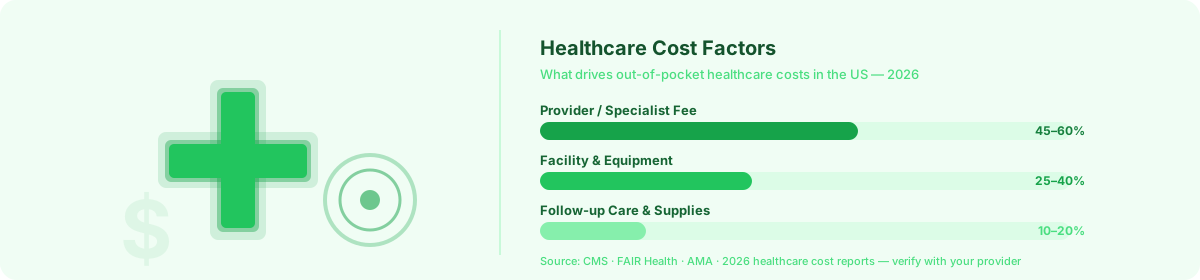
Dental specialists (oral surgeons, periodontists) charge 15–30% more than general dentists but handle complex cases better. Dental school clinics charge 40–60% less than private practices. Urban practices charge 20–35% more than suburban/rural.
5. Dental Implants vs. Alternatives: Cost Comparison
Dental bridge: $2,500–$5,000 (crowns on adjacent teeth, no surgery, lasts 10–15 years). Removable partial denture: $1,000–$2,500 (cheaper, but less comfortable, affects speech). Flipper (temporary tooth): $300–$500. Single dental implant: $3,000–$6,000 (30+ year lifespan, doesn't affect adjacent teeth, most natural feel). For a single missing tooth, an implant becomes cost-competitive with a bridge over 15+ years. For multiple missing teeth, All-on-4 at $25,000–$50,000 total beats individual implants at $50,000–$150,000+
6. Financing Options for Dental Implants
CareCredit: 0% interest for 12–24 months if paid in full; widely accepted at dental offices. Alphaeon Credit: similar terms, 0% for 18 months. Dental membership plans (not insurance): $100–$400/year gives 15–40% discounts at participating dentists. Some practices offer in-house payment plans. Healthcare FSA/HSA: dental implants are FSA/HSA eligible — use pre-tax dollars to save 20–35% depending on your tax bracket. Insurance add-ons: dental supplement riders through some health plans now cover $1,000–$2,000 per implant.
7. Dental Tourism for Implants
Mexico (Los Algodones, Tijuana, Cancún): $800–$1,800/implant all-in vs. $4,500 US average. Total savings on two implants: $5,000–$7,000 after travel. Costa Rica, Colombia, and Hungary offer similar savings with high-quality facilities. Risks: warranty enforcement is harder across borders, follow-up care complexity, and quality variation. Best candidates: healthy patients needing multiple implants who can plan 7–14 days abroad. Always verify accreditation (JCI-accredited clinics match US standards) and get a full treatment plan before booking travel.
8. Dental Implant Cost Without Insurance
Standard dental insurance typically does NOT cover implants, classifying them as cosmetic. Without insurance, a single implant runs $3,000–$6,000 out-of-pocket. Ways to reduce cost without insurance: (1) Dental savings plans (Careington, Aetna Dental Access) cost $100–$250/year and give 15–40% discounts at participating dentists — a better deal than most insurance for implant patients. (2) Dental schools offer implants at 40–60% of private practice rates under supervised faculty. (3) CareCredit or Alphaeon 0% financing for 12–24 months spreads cost with no interest if paid in time. (4) FSA/HSA pre-tax accounts: dental implants ARE eligible — using a $5,000 FSA saves $1,100–$1,850 depending on your tax bracket. Some newer dental insurance plans (Guardian, MetLife) now cover $1,000–$2,000 per implant after a waiting period — worth exploring if you have 6+ months lead time.
8. Choosing the Right Implant Dentist
For single implants: a general dentist with implant training (AAID fellowship or evidence of 100+ implant cases) is sufficient and often less expensive. For complex cases (bone grafting, multiple implants, full-arch): choose a periodontist or oral surgeon with a CBCT scanner in-office. Red flags to avoid: unusually low prices without explanation, no CT scan in treatment plan, no written warranty on implant. Ask: 'How many implants have you placed?' (minimum 200+ for confidence), 'Do you place and restore in-house?' (one doctor for placement AND crown = better coordination).
9. The Implant Timeline: What to Expect
Month 1: consultation, X-rays, 3D CT scan, treatment plan, any needed extractions. Months 1–3: bone graft healing (if needed). Month 3–4: implant post placement surgery (30–60 minutes under local anesthesia). Months 4–8: osseointegration — bone fuses to titanium post. Month 8–9: abutment placement; impressions taken. Month 9–10: permanent crown placed. 'Same-day teeth' (immediate loading protocols) can compress the timeline to 1 day for qualified patients, but traditional staged healing has higher long-term success rates for complex cases.
10. Implant Brand Comparison: Straumann vs. Nobel Biocare vs. Zimmer
Your dentist's choice of implant brand affects your total cost — premium brands like Straumann and Nobel Biocare cost more but carry the deepest clinical evidence base. Here's how the major systems compare:
| Brand | Origin | Patient Cost/Tooth | 10-Yr Success | Known For |
|---|---|---|---|---|
| Straumann | Switzerland | $4,800–$7,000 | 98.8% | SLActive surface; broadest peer-reviewed evidence base |
| Nobel Biocare | Sweden | $4,500–$6,500 | 97.8% | NobelActive design; original osseointegration research lineage |
| Zimmer Biomet | USA | $4,000–$6,000 | 97.2% | Tapered Screw-Vent; widely available across US practices |
| BioHorizons | USA | $3,500–$5,500 | 96.5% | Laser-Lok surface; mid-range price point with solid evidence |
| Generic / House Brand | Varies | $1,500–$3,500 | 92–95% | Used at discount clinics and dental tourism destinations |
Sources: AAID implant registry data, peer-reviewed meta-analyses. Success rate = implant still in function at 10 years. Patient cost includes post, abutment, and crown (national average).
All FDA-approved major brands have excellent long-term outcomes. The 1–2% difference in 10-year success rate matters most for high-risk patients (smokers, diabetics). For healthy patients, choosing between Straumann and Nobel Biocare is mainly a cost decision. Ask your dentist what brand they use and how many cases they've done with that system — provider experience matters more than brand for most patients.
Dental Implant Cost Breakdown: What You're Actually Paying For
Based on national average project cost. Your breakdown may vary by material choice and contractor.
| Cost Category | % of Total | Note |
|---|---|---|
| Implant Post (titanium) | | Titanium screw surgically placed in jawbone |
| Abutment Connector | | Connector piece between post and crown |
| Dental Crown | | Visible porcelain or zirconia tooth replacement |
| Surgery & Anesthesia | | Oral surgeon fees, sedation/local anesthesia |
| X-rays, CT Scan & Planning | | Cone beam CT for implant placement planning |
| Follow-up & Misc. | | Post-op visits, adjustments |
2026 Cost Reference Table
| Type / Option | Typical Cost Range |
|---|---|
| Single implant (post + abutment + crown) | $3,000 – $6,000 |
| Minor bone graft (per site) | $800 – $1,500 |
| Sinus lift (per side) | $2,500 – $4,000 |
| All-on-4 (per arch) | $12,000 – $25,000 |
| All-on-6 (per arch) | $16,000 – $30,000 |
| Implant-supported denture (per arch) | $8,000 – $16,000 |
Frequently Asked Questions
A single dental implant costs $3,000–$6,000 all-in (post + abutment + crown), with a national average of $4,500. The price varies by provider, location, and whether bone grafting is needed. Bone grafting adds $800–$4,000 per site.
Most dental insurance plans do NOT cover implants, treating them as cosmetic. Some newer plans cover $1,000–$1,500 per tooth if the loss was from injury. Flexible Spending Accounts (FSA) and Health Savings Accounts (HSA) can be used for dental implants.
With proper care, dental implants can last 25+ years or a lifetime. The implant post itself rarely fails (98%+ success rate at 10 years). The crown may need replacement after 15–25 years. Smoking and poor oral hygiene are the top risk factors for implant failure.
The dental implant process takes 3–9 months: (1) Consultation + X-rays / 3D scan — assess bone density. (2) Tooth extraction if needed (heals 6–8 weeks). (3) Bone graft if needed (heals 3–6 months). (4) Implant post placement — titanium screw inserted into jawbone under local anesthesia. (5) Osseointegration — bone fuses to implant over 3–6 months. (6) Abutment placement. (7) Crown attachment — permanent tooth placed. Most patients report mild discomfort managed with OTC pain relievers.
The implant procedure itself is performed under local anesthesia — most patients feel pressure but not pain during surgery. Post-procedure soreness (days 1–3) is typically managed with ibuprofen. Bone grafting causes more swelling than implant placement alone. Most patients return to work within 1–2 days. The most painful part is often the tooth extraction before implant placement, not the implant itself.
All-on-4 uses 4 implants to support a full arch of 12–14 teeth, costing $12,000–$25,000 per arch vs. $100,000+ for individual implants for every tooth. All-on-4 is faster (often same-day teeth) and more affordable for full-mouth reconstruction. Traditional single implants are better for replacing 1–3 missing teeth when surrounding teeth are healthy.
Ways to reduce dental implant costs: (1) Dental schools — licensed dentists perform implants under supervision at 50–70% below market price. (2) Dental savings plans (Careington, Denali) — not insurance, but 20–50% discounts at participating dentists. (3) Dental tourism — Mexico border cities like Los Algodones average $1,500–$2,000 per implant. (4) Implant centers vs. general dentists — dedicated implant centers often bundle costs for better pricing.
Yes, but it's more complex. Significant bone loss requires bone grafting before implant placement. Sources: synthetic bone material, cadaver bone, your own bone (from jaw or hip). Costs add $800–$4,000 per graft site. Alternatives if bone loss is severe: zygomatic implants (anchored in cheekbone), mini implants, or implant-supported dentures that require less bone volume. A CBCT 3D scan determines exact bone volume available.
Dental implant success rate is 95–98% at 10 years in healthy patients. Risk factors that increase failure: smoking (2–3× higher failure rate), poorly controlled diabetes, osteoporosis, prior radiation to jaw, insufficient bone volume, and poor oral hygiene. Early failure (within 3 months) is usually due to osseointegration failure. Late failure (years later) is usually from peri-implantitis (gum disease around implant). Failed implants can usually be replaced after healing.
Dental implants are expensive because they involve multiple specialized components and procedures: (1) The titanium implant post ($500–$1,000 for the implant itself), (2) The abutment connector piece ($300–$500), (3) The porcelain crown ($1,000–$2,000), (4) Surgeon's fees for oral surgery under local anesthesia, (5) Pre-surgery imaging (CBCT 3D scan: $250–$500), and (6) Multiple visits over 3–9 months. Compare to dentures ($1,500–$3,000) which don't last as long. The cost reflects a permanent tooth replacement designed to last 25+ years with proper care.
Traditional Medicare (Parts A and B) does NOT cover dental implants or most dental care. Some Medicare Advantage (Part C) plans include dental coverage, but most limit implant coverage to $1,000–$2,500 per year — which covers only a portion of implant costs. For seniors, the most cost-effective options for dental implants are: dental savings plans ($150–$200/year, 20–50% discounts at participating dentists), dental school clinics (50–70% below market rate), or medical tourism (Mexico, Costa Rica average $1,500–$2,000 per implant). Check if your Medicare Advantage plan has dental benefits — it varies significantly by plan.
Cost Trends — 2022 to 2026
How costs have changed year over year. Useful for budgeting and understanding market direction.
| Year | Average Cost | Change vs Prior Year |
|---|---|---|
| 2022 | $3,900 | Baseline |
| 2023 | $4,100 | ↑ 5.1% |
| 2024 | $4,300 | ↑ 4.9% |
| 2025 | $4,400 | ↑ 2.3% |
| 2026 | $4,500 | ↑ 2.3% |
National average estimates based on industry surveys and contractor pricing data. Regional costs may vary significantly.
Data Sources
- • Centers for Medicare & Medicaid Services (CMS) — Healthcare cost benchmarks and geographic cost adjustment factors
- • American Academy of Implant Dentistry (AAID) — Implant procedure cost surveys and success rate data
- • American Association of Oral and Maxillofacial Surgeons (AAOMS) — Procedure fee surveys by specialty and region
- • Bureau of Labor Statistics (BLS) — Dental occupations wages — State-level dental professional wage data
Find Dental Implant Specialists Near You
Compare dental implant providers. Prices vary 30–50% between practices for the same procedure.
Advertising disclosure: links above are paid partnerships. Learn more.
Your Estimate
Low
—
Average
—
High
—
Cost Breakdown
Cost Itemization
| Category | Amount | % |
|---|
Paid partnership · disclosure
Tips Before You Start
- ✓ Dental implant prices include 3 components: implant post, abutment, and crown
- ✓ Bone grafting ($800–$3,000) is needed in 40% of implant cases — ask about this in consultations
- ✓ Dental schools offer implants at 40–60% of private practice rates
- ✓ Dental savings plans (not insurance) can reduce costs by 15–40%
- ✓ Financing through CareCredit or Alphaeon is available at 0% for 12–24 months
How to Finance This Project
Most homeowners finance large projects rather than paying cash. Compare your options:
HELOC
Home Equity Line of Credit. Uses your home equity as collateral. Rates typically 7–9% variable.
- ✓ Lowest interest rates
- ✓ Tax-deductible interest (if used for home improvement)
- ✗ Requires home equity (20%+)
- ✗ Variable rate risk
Personal Loan
Unsecured loan. No home equity needed. Fixed rates typically 8–20% depending on credit score.
- ✓ Fast funding (1–5 days)
- ✓ Fixed monthly payment
- ✓ No collateral required
- ✗ Higher rate than HELOC
Contractor Financing
Many contractors offer financing through GreenSky, Synchrony, or similar. Watch for deferred interest.
- ✓ Often 0% promo period (12–18 months)
- ✓ Convenient, one-stop
- ✗ High rate after promo ends
- ✗ Deferred interest traps
Compare home improvement loan rates
Get pre-qualified in 2 minutes. No impact to your credit score.
Cost by State — 2026
Based on national average pricing adjusted for local labor and material costs.
Alabama
$2,970 – $5,148
$3,960
Alaska
$4,894 – $8,483
$6,525
Arizona
$3,274 – $5,675
$4,365
Arkansas
$2,801 – $4,856
$3,735
California
$4,995 – $8,658
$6,660
Colorado
$3,780 – $6,552
$5,040
Connecticut
$4,320 – $7,488
$5,760
Delaware
$3,645 – $6,318
$4,860
Florida
$6,244 – $10,823
$8,325
Georgia
$3,206 – $5,558
$4,275
↑ Most Expensive States
- 1 Florida $8,325
- 2 Hawaii $7,560
- 3 New York $6,840
- 4 California $6,660
- 5 Alaska $6,525
↓ Least Expensive States
- 1 Mississippi $3,600
- 2 Arkansas $3,735
- 3 West Virginia $3,735
- 4 Kentucky $3,825
- 5 Oklahoma $3,825
Cost in Major US Cities — 2026
City-level estimates based on local labor costs and market conditions. Costs in high-cost metros like NYC and Los Angeles are typically 30–65% above the national average.
| City | Typical Range | Avg Cost |
|---|---|---|
| New York | $5,940 – $9,653 | $7,425 |
| Los Angeles | $5,688 – $9,243 | $7,110 |
| Chicago | $4,392 – $7,137 | $5,490 |
| Houston | $3,888 – $6,318 | $4,860 |
| Phoenix | $3,708 – $6,026 | $4,635 |
| Philadelphia | $4,248 – $6,903 | $5,310 |
| San Antonio | $3,780 – $6,143 | $4,725 |
| San Diego | $5,220 – $8,483 | $6,525 |
| Dallas | $4,032 – $6,552 | $5,040 |
| Austin | $4,140 – $6,728 | $5,175 |
Estimates derived from national average adjusted by metro-area labor and material cost indices. Actual quotes from local contractors may vary 20–35%.