True Cost of an Employee Calculator 2026
Calculate the true annual cost of hiring an employee beyond salary — payroll taxes, health insurance, 401(k) match, PTO, equipment, and overhead.
Enter Your Details
What Affects the Cost?
1. Mandatory Employer Costs (Beyond Salary)
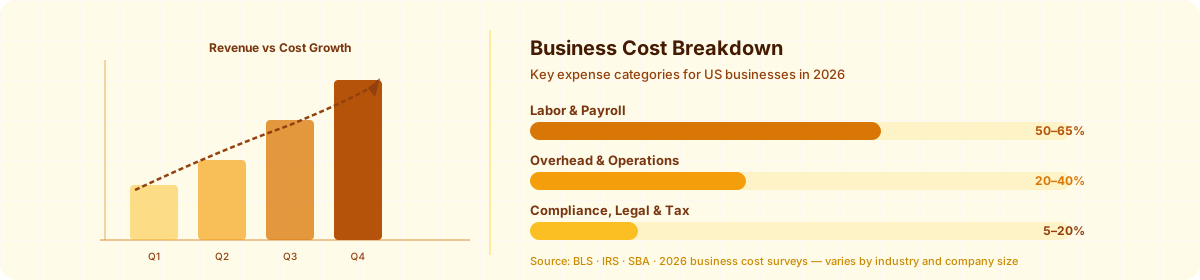
FICA payroll taxes: 7.65% of wages (6.2% Social Security up to $168,600 + 1.45% Medicare — no cap). Federal unemployment (FUTA): 0.6–6% on first $7,000/year. State unemployment (SUTA): 0.1–6% depending on state and claims history. Workers' compensation: $0.50–$12/100 of payroll. These alone add 10–15% above salary.
2. Benefits Costs
Employer health insurance contribution: $500–$1,200/month per employee (family coverage: $1,200–$2,000/month). Dental/vision: $30–$80/month. 401(k) match at 3–4%: $1,800–$4,000/year on $60K salary. Life insurance: $5–$20/month. PTO/vacation: cost equals days off × daily rate (2 weeks = ~4% of salary). Total benefits add 20–35% above base salary.
3. Hidden/Overhead Costs
Recruiting and onboarding: $3,000–$7,000 one-time per hire. Equipment (laptop, phone, tools): $1,500–$5,000 first year, $500–$1,500 ongoing. Software licenses (Slack, Microsoft 365, etc.): $500–$2,000/year. Office space: $5,000–$20,000/year per employee in most markets. Training: $1,000–$3,000 in year one. Management overhead: ~10–15% of their time.
4. True Cost of Employee by Salary Level — 2026
The 1.30× multiplier is an average — actual cost depends on benefits and overhead. Below are fully loaded costs for an office-based employee with standard benefits (health + 401k + PTO). Productive hours = 1,840/yr (2,080 minus PTO/holidays/sick):
| Base Salary | True Annual Cost | Cost/Productive Hour | Multiplier | Contractor Break-Even Rate |
|---|---|---|---|---|
| $40,000/yr | $52,000–$60,000 | $28–$33/hr | 1.30–1.50× | Contractor at $40–$50/hr is cost-equivalent |
| $60,000/yr | $78,000–$90,000 | $42–$49/hr | 1.30–1.50× | Contractor at $60–$75/hr is cost-equivalent |
| $75,000/yr | $97,500–$112,500 | $53–$61/hr | 1.30–1.50× | Contractor at $75–$90/hr is cost-equivalent |
| $100,000/yr | $130,000–$155,000 | $71–$84/hr | 1.30–1.55× | Contractor at $100–$120/hr is cost-equivalent |
| $150,000/yr | $195,000–$240,000 | $106–$130/hr | 1.30–1.60× | Contractor at $150–$185/hr is cost-equivalent |
Contractor break-even = the hourly 1099 rate where hiring an employee becomes cheaper. Contractors cost more per hour but you avoid benefits, payroll taxes, and long-term commitment. For ongoing full-time roles (30+ hrs/week, 12+ months), employees are typically 20–30% more cost-effective than long-term contractors. Salary × 1.30 is the standard financial model for employee cost budgeting and project pricing.
2026 Cost Reference Table
| Type / Option | Typical Cost Range |
|---|---|
| $50K salary — basic benefits | $62,000 – $72,000/year true cost |
| $75K salary — standard benefits | $96,000 – $112,000/year true cost |
| $100K salary — full benefits | $130,000 – $155,000/year true cost |
| $150K salary — full benefits + equity | $195,000 – $230,000/year true cost |
| Part-time employee (20 hrs/wk) | $28,000 – $38,000/year true cost |
| 1099 contractor (no benefits) | 1.05–1.15× their invoice rate |
Frequently Asked Questions
The true cost of an employee is typically 1.25–1.40× their salary. For a $60,000 salary, expect $75,000–$84,000 in total annual cost. This includes: mandatory payroll taxes (7.65%), health insurance ($6,000–$14,000/year), 401(k) match, workers' comp, unemployment insurance, PTO, and equipment/software.
Contractors (1099) typically cost 20–30% more per hour or project, but you avoid benefits costs (health insurance, 401k, PTO) and payroll taxes. For short-term or specialized work, contractors are usually more cost-effective. For ongoing full-time roles (30+ hours/week), employees are typically more economical long-term.
Employers pay an average of $7,000–$9,000/year for single employee coverage and $20,000–$23,000/year for family coverage (employer's share). Small businesses (under 50 employees) average $500–$700/month per employee for a mid-tier health plan. The ACA requires businesses with 50+ full-time employees to offer health insurance.
Turnover costs 50–200% of the departing employee's annual salary. Entry-level positions: 30–50% of salary ($15,000–$25,000 for a $50K role). Mid-level professionals: 100–150% of salary. Senior or specialized roles: up to 200%+ ($200,000 for a $100K executive). Costs include: recruiting fees ($3,000–$7,000), 2–4 months of productivity loss, new hire training (1–3 months), and temp staffing. High turnover is almost always more expensive than retention raises.
Employer-side payroll taxes in 2026: Social Security: 6.2% on wages up to $176,100 (2026 wage base). Medicare: 1.45% on all wages (no cap). Federal Unemployment (FUTA): 0.6–6% on first $7,000/year. State Unemployment (SUTA): 0.1–8.5% depending on state and employer claims history. Workers' compensation insurance: $0.50–$12 per $100 of payroll by industry. Total employer tax burden typically adds 10–15% above gross wages.
Remote employees eliminate office costs ($5,000–$20,000/year per person) but add: home office stipend ($500–$1,500/year), equipment shipping and setup ($1,000–$2,000), collaboration software (Slack, Zoom, etc.: $200–$600/year), and multi-state payroll compliance if the employee is in a different state ($500–$2,000/year for tax registration and compliance). True total cost of a remote employee: 1.20–1.30× salary — slightly less than in-office employees primarily due to eliminated real estate costs.
To calculate your true hourly employee cost: (1) Start with fully loaded annual cost = salary × 1.30 (adds taxes, benefits, and overhead). (2) Calculate paid hours per year = 52 weeks × 40 hours = 2,080 hours. (3) Subtract non-productive time: PTO (15 days = 120 hrs), holidays (10 days = 80 hrs), sick days (5 days = 40 hrs) = 240 hours. (4) Productive hours = 2,080 - 240 = 1,840 hours. (5) Hourly fully-loaded cost = Annual fully-loaded cost ÷ 1,840 productive hours. Example: $60K salary × 1.30 = $78,000 ÷ 1,840 = $42.39/productive hour. This figure is what you need to earn per hour of that employee's time to justify their cost. Use this for pricing projects or evaluating contractor vs. hire decisions.
Monthly cost components beyond salary for an average $5,000/month ($60K/year) employee in 2026: Employer payroll taxes (FICA, FUTA, SUTA): $575–$700/month. Health insurance employer share: $500–$750/month (single coverage). 401k match (3% typical): $150/month. Workers' comp insurance: $50–$200/month depending on industry. Paid time off accrual (3 weeks/year): $350/month equivalent. Equipment, software licenses, training: $100–$300/month. Total ongoing monthly cost above salary: $1,725–$2,450/month. Annual benefit cost for one mid-range employee: $20,700–$29,400 above their base salary. These numbers are why the 1.25–1.40× salary multiplier is the industry standard for total employee cost modeling.
The fully-loaded cost of an employee includes all direct and indirect costs: Base salary (100%) + Employer payroll taxes (7.65% FICA + 0.6–2% FUTA/SUTA = ~8–10%) + Health insurance (10–15%) + Retirement match (2–5%) + Workers' comp (0.5–5% depending on industry) + PTO/holiday pay (6–10%) + Equipment and software ($2,000–$8,000/year) + Training and development ($500–$2,000/year) + Office space and overhead ($3,000–$15,000/year per employee in-office). Adding these up: the true fully-loaded cost of an employee is typically 1.25–1.45× their base salary for employees with standard benefits, or 1.5–2.0× for employees in high-overhead environments (office space, expensive equipment). A $70,000 salary employee costs $87,500–$101,500 in fully-loaded cost. Use the 1.35× rule as a quick estimate for most small business scenarios.
Manage Employee Costs Efficiently
Gusto automates payroll taxes, benefits administration, and compliance — starting at $40/month. Pays a $200 referral per new customer.
Advertising disclosure: links above are paid partnerships. Learn more.
Your Estimate
Low
—
Average
—
High
—
Cost Breakdown
Cost Itemization
| Category | Amount | % |
|---|
Paid partnership · disclosure
Tips Before You Start
- ✓ Employer payroll taxes alone add 7.65% to every dollar of wages (FICA: Social Security + Medicare)
- ✓ Health insurance costs employers $7,000–$14,000/year per employee in 2026
- ✓ Factor 2 weeks PTO + federal holidays = ~15 days/year in unproductive paid time
- ✓ Turnover costs 50–200% of annual salary — retention is your best cost-reduction strategy
- ✓ Contractors (1099) cost 20–30% more per hour but save on benefits and payroll taxes
Cost by State — 2026
Based on national average pricing adjusted for local labor and material costs.
Alabama
$56,100 – $97,240
$74,800
Alaska
$92,438 – $160,225
$123,250
Arizona
$61,838 – $107,185
$82,450
Arkansas
$52,913 – $91,715
$70,550
California
$94,350 – $163,540
$125,800
Colorado
$71,400 – $123,760
$95,200
Connecticut
$81,600 – $141,440
$108,800
Delaware
$68,850 – $119,340
$91,800
Florida
$117,938 – $204,425
$157,250
Georgia
$60,563 – $104,975
$80,750
↑ Most Expensive States
- 1 Florida $157,250
- 2 Hawaii $142,800
- 3 New York $129,200
- 4 California $125,800
- 5 Alaska $123,250
↓ Least Expensive States
- 1 Mississippi $68,000
- 2 Arkansas $70,550
- 3 West Virginia $70,550
- 4 Kentucky $72,250
- 5 Oklahoma $72,250
Cost in Major US Cities — 2026
City-level estimates based on local labor costs and market conditions. Costs in high-cost metros like NYC and Los Angeles are typically 30–65% above the national average.
| City | Typical Range | Avg Cost |
|---|---|---|
| New York | $112,200 – $182,325 | $140,250 |
| Los Angeles | $107,440 – $174,590 | $134,300 |
| Chicago | $82,960 – $134,810 | $103,700 |
| Houston | $73,440 – $119,340 | $91,800 |
| Phoenix | $70,040 – $113,815 | $87,550 |
| Philadelphia | $80,240 – $130,390 | $100,300 |
| San Antonio | $71,400 – $116,025 | $89,250 |
| San Diego | $98,600 – $160,225 | $123,250 |
| Dallas | $76,160 – $123,760 | $95,200 |
| Austin | $78,200 – $127,075 | $97,750 |
Estimates derived from national average adjusted by metro-area labor and material cost indices. Actual quotes from local contractors may vary 20–35%.