HVAC Replacement Cost Calculator 2026
Get an accurate 2026 estimate for central AC, heat pump, or full HVAC system replacement — adjusted for your home size, brand tier, and state. Data verified June 2026 from 56,000+ real projects.
Enter Your Details
What Affects the Cost?
1. System Type (biggest cost driver)
A central AC-only replacement costs $3,500–$7,500. A full HVAC system (AC + furnace) runs $7,000–$14,000. Heat pump systems cost $5,000–$12,000 but qualify for up to $2,000 in federal tax credits and often $300–$800 in utility rebates. Mini-split systems run $3,000–$10,000 depending on zones.
2. Home Size & Tonnage
HVAC is sized in 'tons' of cooling capacity. A 1,500 sqft home needs 2.5 tons; a 3,000 sqft home needs 4–5 tons. Each ton of capacity adds $500–$800 to equipment costs. An improperly sized system is the #1 cause of premature HVAC failure, so always get a Manual J load calculation.
3. SEER Rating & Efficiency
SEER (Seasonal Energy Efficiency Ratio) measures efficiency. The federal minimum is 14 SEER in most states. A 16 SEER unit costs ~$500 more than minimum but saves $150–$300/year on energy bills. A 20 SEER premium unit costs $1,500 more but pays back in 6–8 years.
4. Your State
Labor and refrigerant costs vary significantly. California and New York average 40–50% above the national average. Texas and Arizona are near average. States with extreme climates (Florida, Texas) have more competition, often keeping prices closer to the national average.
5. HVAC Cost Per Square Foot (2026)
A common way contractors size HVAC is by square footage. For budgeting purposes, expect $4–$7/sqft for a complete HVAC system replacement (equipment + labor + materials). A 1,500 sqft home: $6,000–$10,500. A 2,500 sqft home: $10,000–$17,500. A 4,000 sqft home: $16,000–$28,000. These per-sqft figures assume standard central forced-air systems. Heat pump installations run slightly higher ($5–$9/sqft). Mini-split systems vary widely by zone count. Larger homes actually cost LESS per sqft because a single outdoor unit can serve more area. Competing sources (Modernize, HomeAdvisor) report $3.50–$7.50/sqft for full system replacement nationally, consistent with these estimates.
6. HVAC Cost by House Size — Common Sizes (2026)
The most searched HVAC questions involve specific home sizes. Here are full-system (AC + furnace) replacement costs by square footage:
| Home Size | Tonnage Needed | AC Only | Full HVAC (AC + Furnace) | Heat Pump System |
|---|---|---|---|---|
| 1,000 sq ft | 1.5–2 tons | $3,500–$5,500 | $6,000–$9,000 | $5,500–$9,000 |
| 1,500 sq ft | 2–2.5 tons | $4,000–$7,000 | $7,500–$12,000 | $7,000–$11,500 |
| 2,000 sq ft | 2.5–3.5 tons | $4,500–$8,500 | $8,500–$14,500 | $8,000–$13,500 |
| 3,000 sq ft | 3.5–5 tons | $6,000–$11,000 | $11,000–$18,000 | $10,500–$16,500 |
| 4,000 sq ft | 5–6 tons | $8,000–$14,000 | $14,000–$24,000 | $13,000–$21,000 |
Costs assume mid-range 16 SEER2 equipment and standard installation. Heat pump costs are before federal tax credits ($2,000 max). Add $3,500–$9,000 if ductwork replacement is needed. State labor rates vary 30–50% from national average.
7. Costco HVAC vs. Local Contractors — What to Expect
Costco offers HVAC installation through its Lennox partnership program, available to Costco members in select areas. Costco HVAC pricing typically runs $8,000–$16,000 for a full system — comparable to or slightly above a competitive local contractor bid for equivalent equipment. The advantage of the Costco program is a pre-vetted installer network and Costco's satisfaction guarantee. However, Costco's program has limited availability, is not available in all markets, and offers less flexibility in equipment selection. For most homeowners, getting 3 competitive quotes from local licensed HVAC contractors produces equivalent or better pricing with more control over equipment brand and contractor selection. CostPrism's estimates are consistent with both local contractor quotes and the Costco program's published ranges.
8. HVAC Cost by Brand — Trane, Carrier, Lennox, Goodman & More (2026)
Brand is one of the biggest variables in HVAC pricing. Below are full system replacement costs (AC + furnace, 3-ton for a 2,000 sqft home) including installation labor — not just equipment prices. All brands use similar R-410A/R-454B refrigerant; price differences reflect reliability reputation, dealer network, and premium features.
| Brand | Tier | Full System (AC+Furnace) | Notable Models |
|---|---|---|---|
| Goodman | Budget | $5,500 – $9,000 | GSX14, GMSS96 — reliable, widely available parts |
| Rheem / Ruud | Budget-Mid | $6,000 – $10,500 | RA14, RGEA — good warranty, sold at Home Depot |
| York / Johnson Controls | Mid | $7,000 – $12,000 | YCG, TM9, YZF — strong value, quiet operation |
| Carrier | Mid-Premium | $7,500 – $14,000 | Comfort 24ACC, Performance 25VNA — strong dealer network |
| Trane | Mid-Premium | $7,500 – $14,500 | S-Series, XR15/16 — top reliability scores, US manufacturing |
| Lennox | Mid-Premium | $8,000 – $15,000 | Merit ML14XC1, Elite EL16XC1 — sold via Costco program |
| Trane XV Series | Premium | $11,000 – $20,000 | XV18, XV20i — 20–26 SEER, variable-speed, quietest operation |
| Carrier Infinity | Premium | $11,000 – $20,000 | 24VNA, 59MN7 — Greenspeed, smart home integration |
| Lennox Signature | Premium | $12,000 – $22,000 | XC21, SLP99V — highest-efficiency options, very quiet |
Costs shown for 3-ton full system (AC + furnace) including installation labor in a typical US market. Prices 20–40% higher in CA, NY, MA. Budget brands are reliable — Goodman and Rheem power millions of US homes. Premium brands offer higher efficiency and longer warranties, not necessarily better reliability. Focus on the installing contractor's reputation and SEER rating over brand prestige.
HVAC Replacement Cost Breakdown: Equipment vs. Labor
Based on national average project cost. Your breakdown may vary by material choice and contractor.
| Cost Category | % of Total | Note |
|---|---|---|
| Equipment / Unit Cost | | AC unit, furnace, or heat pump hardware |
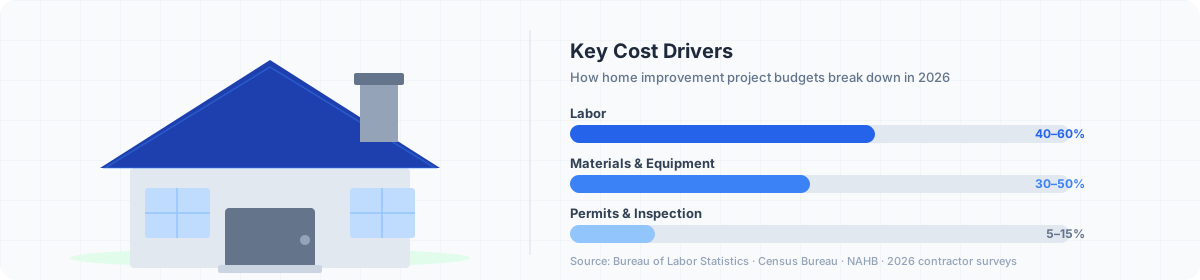
| Labor & Installation | | HVAC technician time, typically 4–8 hours |
| Refrigerant & Materials | | Refrigerant charge, copper lines, fittings |
| Permits & Overhead | | Mechanical permit, disposal, warranty registration |
2026 Cost Reference Table
| Type / Option | Typical Cost Range | Note |
|---|---|---|
| Central AC (unit only replacement) | $4,500 – $9,500 | |
| Gas furnace replacement | $3,500 – $7,500 | |
| Full HVAC system (AC + furnace) | $8,500 – $16,000 | |
| Heat pump system | $7,000 – $14,000 | |
| Mini-split (single zone) | $3,500 – $7,000 | |
| Mini-split (multi-zone, 3 zones) | $9,000 – $18,000 | |
| Ductwork replacement (full home) | $3,500 – $9,000 | Add-on |
Frequently Asked Questions
The national average is $9,800 for a full HVAC system (AC + furnace). Central AC-only replacement runs $5,000–$9,500. Heat pump systems cost $7,000–$14,000 before tax credits. Modernize reports $11,590–$14,100 from 56,000 real projects. Costs vary significantly by system type, home size, efficiency rating, and state.
The general rule: if repair cost exceeds 50% of the cost of a new system, replace it. Also consider age — if your AC is 15+ years old or your furnace is 20+ years old, replacement is often smarter than repair. New systems are also 30–50% more energy-efficient than older models.
16 SEER is the sweet spot for most homeowners — it qualifies for most utility rebates, has a reasonable payback period (4–6 years in energy savings), and is widely available. If you live in a very hot climate and run AC 8+ months/year, a 18–20 SEER unit may pay off faster.
The Inflation Reduction Act provides a 30% tax credit up to $2,000 for qualified heat pumps (air-source, geothermal). Efficient furnaces and AC units may qualify for up to $600. Credits apply to equipment costs, not installation. Consult a tax professional for your specific situation.
A standard central AC or furnace replacement takes 4–8 hours for a licensed HVAC technician. Full system replacement (AC + furnace) takes 6–10 hours. Ductwork replacement adds 1–2 days. Mini-split systems take 4–6 hours per zone. Most installations are completed in a single day. Schedule in spring or fall for fastest availability — summer installations often require 2–3 week waits during peak cooling season demand.
Top HVAC brands by tier: Budget: Goodman, Ameristar, Daikin — reliable, widely available parts. Mid-range (best value): Carrier, Trane, Lennox, Rheem, Ruud — excellent quality/value balance with strong dealer networks. Premium: Trane XV Series, Carrier Infinity, Lennox Dave Lennox Signature — highest efficiency (20–26 SEER2), quietest operation, advanced smart home integration. Most HVAC contractors recommend mid-range brands for most homeowners; premium units have 8–12 year payback periods on energy savings alone.
Yes — most jurisdictions require a mechanical permit for HVAC replacement, including like-for-like equipment swaps. Permits cost $50–$200 and require a post-installation inspection. Licensed HVAC contractors handle permit pulling as part of the project. Unpermitted HVAC work can void homeowners insurance claims, cause issues during home sales, and result in fines. Never accept a contractor's offer to skip permits — it's a red flag for unlicensed work.
Heat pumps are the most efficient option for most US climates. They provide both heating and cooling from a single system, using 30–50% less energy than gas furnaces in moderate climates. Modern cold-climate heat pumps operate down to -13°F, making them viable in most states. Advantages: lower operating costs, single-system simplicity, qualifies for $2,000 federal tax credit. Considerations: higher upfront cost ($7,000–$14,000 vs $4,000–$9,000 for AC-only), and gas furnaces remain more effective in extreme cold below 0°F for homes in Minnesota, Wisconsin, or similar climates.
HVAC sizing is based on BTUs per hour — roughly 12,000 BTUs (1 ton) per 500–600 sq ft in moderate climates. A 1,500 sq ft home typically needs 2.5 tons; a 2,000 sq ft home needs 3–3.5 tons; a 3,000 sq ft home needs 4–5 tons. Climate zone, insulation, ceiling height, and window area also affect sizing. Always get a Manual J load calculation from a licensed HVAC contractor — an oversized or undersized system is the #1 cause of premature failure and high energy bills.
Central air conditioners last 15–20 years; furnaces 15–30 years; heat pumps 10–15 years; mini-splits 15–20 years. Systems in extreme climates (Florida, Arizona) may last fewer years due to heavier usage. Annual maintenance (filter changes, coil cleaning, refrigerant checks) extends lifespan significantly. If your AC is 15+ years old or your furnace is 20+ years old, budgeting for replacement is wise — systems lose efficiency gradually and replacement avoids an emergency breakdown in peak season.
In most climates, yes — heat pumps are 200–300% efficient (they move heat rather than generate it), costing $500–$900/year less than gas heating in mild climates. However, in very cold climates (below 0°F regularly), heat pumps require electric backup strips that can spike costs. Modern cold-climate heat pumps work down to -13°F. Compare your local electricity vs. gas rates: if electricity costs less than 3× your gas rate per equivalent BTU, a heat pump is likely cheaper to run.
Full ductwork replacement adds $2,500–$7,500 to an HVAC project (for a 1,500–2,500 sq ft home). Partial duct repair runs $300–$1,000 per section. Most HVAC systems can reuse existing ductwork if it's in good condition and properly sealed. Ask your contractor to do a duct leakage test — leaky ducts waste 20–30% of conditioned air, increasing energy bills significantly. New ductwork is recommended if ducts are over 20 years old, heavily corroded, or significantly undersized for the new equipment.
Single-zone mini-split: $1,500–$5,000 installed. Multi-zone mini-split (2–5 zones): $3,000–$12,000 installed. Cost depends on number of zones, BTU capacity, and brand (Mitsubishi, Daikin, Fujitsu are top-tier). Mini-splits are 25–40% more efficient than window units and require no ductwork, making them ideal for additions, garages, and homes without existing ducts. Federal tax credits of up to $2,000 apply to qualifying mini-split heat pumps.
Cost Trends — 2022 to 2026
How costs have changed year over year. Useful for budgeting and understanding market direction.
| Year | Average Cost | Change vs Prior Year |
|---|---|---|
| 2022 | $7,800 | Baseline |
| 2023 | $8,500 | ↑ 9.0% |
| 2024 | $9,100 | ↑ 7.1% |
| 2025 | $9,500 | ↑ 4.4% |
| 2026 | $9,800 | ↑ 3.2% |
National average estimates based on industry surveys and contractor pricing data. Regional costs may vary significantly.
Data Sources
- • Air Conditioning Contractors of America (ACCA) — HVAC installation cost benchmarks and labor standards
- • Bureau of Labor Statistics (BLS) — HVAC mechanics wages — State-level HVAC technician wage data
- • US Department of Energy (DOE) — SEER efficiency standards and energy savings data
- • ENERGY STAR program data — Qualifying equipment cost premiums and rebate data
Get 3 Free HVAC Quotes
Most homeowners save $800–$2,000 by comparing 3 HVAC contractor bids.
Advertising disclosure: links above are paid partnerships. Learn more.
Your Estimate
Low
—
Average
—
High
—
Cost Breakdown
Cost Itemization
| Category | Amount | % |
|---|
Paid partnership · disclosure
Tips Before You Start
- ✓ Get at least 3 quotes — HVAC pricing varies widely by contractor
- ✓ Ask for SEER rating: 16 SEER is standard, 18+ is high-efficiency
- ✓ Check for federal tax credits (up to $2,000 for heat pumps)
- ✓ Ask if new equipment qualifies for utility rebates in your state
- ✓ Never pay more than 30% upfront before installation begins
How to Finance This Project
Most homeowners finance large projects rather than paying cash. Compare your options:
HELOC
Home Equity Line of Credit. Uses your home equity as collateral. Rates typically 7–9% variable.
- ✓ Lowest interest rates
- ✓ Tax-deductible interest (if used for home improvement)
- ✗ Requires home equity (20%+)
- ✗ Variable rate risk
Personal Loan
Unsecured loan. No home equity needed. Fixed rates typically 8–20% depending on credit score.
- ✓ Fast funding (1–5 days)
- ✓ Fixed monthly payment
- ✓ No collateral required
- ✗ Higher rate than HELOC
Contractor Financing
Many contractors offer financing through GreenSky, Synchrony, or similar. Watch for deferred interest.
- ✓ Often 0% promo period (12–18 months)
- ✓ Convenient, one-stop
- ✗ High rate after promo ends
- ✗ Deferred interest traps
Compare home improvement loan rates
Get pre-qualified in 2 minutes. No impact to your credit score.
Cost by State — 2026
Based on national average pricing adjusted for local labor and material costs.
Alabama
$6,468 – $11,211
$8,624
Alaska
$10,658 – $18,473
$14,210
Arizona
$7,130 – $12,358
$9,506
Arkansas
$6,101 – $10,574
$8,134
California
$10,878 – $18,855
$14,504
Colorado
$8,232 – $14,269
$10,976
Connecticut
$9,408 – $16,307
$12,544
Delaware
$7,938 – $13,759
$10,584
Florida
$13,598 – $23,569
$18,130
Georgia
$6,983 – $12,103
$9,310
↑ Most Expensive States
- 1 Florida $18,130
- 2 Hawaii $16,464
- 3 New York $14,896
- 4 California $14,504
- 5 Alaska $14,210
↓ Least Expensive States
- 1 Mississippi $7,840
- 2 Arkansas $8,134
- 3 West Virginia $8,134
- 4 Kentucky $8,330
- 5 Oklahoma $8,330
Cost in Major US Cities — 2026
City-level estimates based on local labor costs and market conditions. Costs in high-cost metros like NYC and Los Angeles are typically 30–65% above the national average.
| City | Typical Range | Avg Cost |
|---|---|---|
| New York | $12,936 – $21,021 | $16,170 |
| Los Angeles | $12,387 – $20,129 | $15,484 |
| Chicago | $9,565 – $15,543 | $11,956 |
| Houston | $8,467 – $13,759 | $10,584 |
| Phoenix | $8,075 – $13,122 | $10,094 |
| Philadelphia | $9,251 – $15,033 | $11,564 |
| San Antonio | $8,232 – $13,377 | $10,290 |
| San Diego | $11,368 – $18,473 | $14,210 |
| Dallas | $8,781 – $14,269 | $10,976 |
| Austin | $9,016 – $14,651 | $11,270 |
Estimates derived from national average adjusted by metro-area labor and material cost indices. Actual quotes from local contractors may vary 20–35%.
Related Guides
View all guides →Now that you have an estimate — get free quotes from pre-screened local contractors. Most homeowners save 15–25% by comparing 3 bids.