Water Heater Replacement Cost Calculator 2026
Get an accurate 2026 estimate for water heater replacement — tank or tankless, gas or electric — including installation labor by state.
Enter Your Details
What Affects the Cost?
1. Tank vs. Tankless Water Heaters
Tank water heaters (40–80 gallons) are the most common type, costing $800–$1,600 installed. They store hot water and are cheaper upfront. Tankless water heaters heat water on demand with no storage tank, lasting 20+ years vs. 8–12 for tank units. Tankless costs $2,000–$4,500 installed but saves $100–$400/year in energy. For most homes, tankless becomes cost-effective after 7–10 years.
2. Gas vs. Electric Cost Comparison
Gas water heaters: $900–$1,800 installed. Operating cost: $400–$600/year. Require gas line and venting. More efficient than electric resistance heating. Electric tank heaters: $700–$1,400 installed. Operating cost: $600–$900/year. No venting required. Heat pump electric heaters: $1,500–$2,500 installed. Operating cost: $200–$350/year — most efficient type available with $300 federal tax credit.
3. Signs Your Water Heater Needs Replacement
Replace when: (1) Age over 10–12 years (tank) or 15+ years (tankless) — efficiency drops significantly. (2) Rusty or discolored hot water — sign of tank corrosion. (3) Rumbling or popping sounds — sediment buildup reduces efficiency and damages tank. (4) Visible rust on tank exterior near the base. (5) Water pooling around base — micro-cracks in tank. (6) Repair costs exceed 50% of replacement — better to replace. Most failures are sudden, so don't wait for a complete failure.
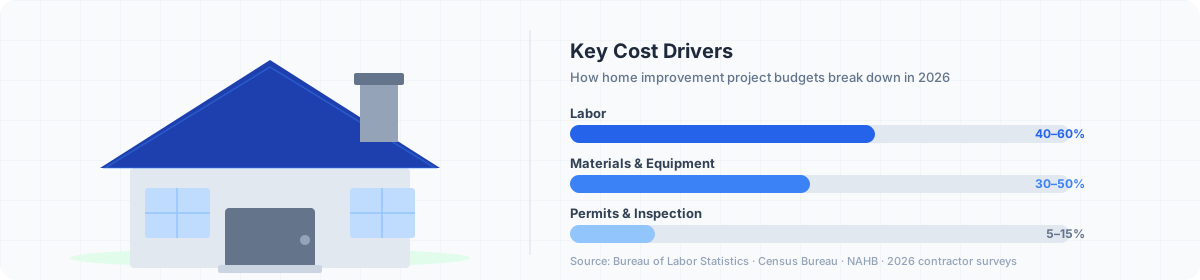
Water Heater Replacement Cost Breakdown
Based on national average project cost. Your breakdown may vary by material choice and contractor.
| Cost Category | % of Total | Note |
|---|---|---|
| Equipment (water heater unit) | | Tank or tankless unit cost |
| Labor (installation) | | Plumber labor, typically 2–4 hours |
| Permits & Inspection | | Required in most jurisdictions |
| Materials & Misc. | | Fittings, expansion tank, straps |
2026 Cost Reference Table
| Type / Option | Typical Cost Range |
|---|---|
| Standard gas tank, 40-gallon | $800 – $1,400 |
| Standard gas tank, 50-gallon | $900 – $1,600 |
| Electric tank, 40-gallon | $700 – $1,200 |
| Electric tank, 50-gallon | $800 – $1,400 |
| Heat pump water heater (50-gal) | $1,500 – $2,500 |
| Tankless gas (whole home) | $2,000 – $4,000 |
| Tankless electric (whole home) | $1,500 – $3,000 |
Frequently Asked Questions
Water heater replacement costs $800–$2,000 on average in 2026. Standard tank models (40–50 gallon gas or electric) run $800–$1,600 installed. Tankless whole-home units cost $2,000–$4,500. Heat pump water heaters run $1,500–$2,500 but qualify for a $300 federal tax credit under the Inflation Reduction Act.
Standard tank replacement takes 2–4 hours for a licensed plumber. Like-for-like swaps (same fuel type, similar capacity) are fastest. Switching from tank to tankless requires additional work for gas line upgrades, electrical panel upgrades (for electric tankless), or new venting — adding 1–3 hours. Permits require an inspection, typically scheduled the next business day.
Tankless water heaters make sense if: you're already replacing a failed tank unit (pay the incremental cost now rather than again in 10 years), you have high hot water demand (large family), or you plan to stay in the home 8+ years. Tankless units cost $1,000–$2,500 more upfront but save $100–$400/year in energy. Payback period: 5–12 years depending on energy prices and usage. They also last 20+ years vs. 8–12 for tank units.
Heat pump water heaters (HPWHs) are 2–3× more efficient than standard electric resistance tank units. They cost $1,500–$2,500 installed and qualify for a $300 federal tax credit. Annual energy savings vs. electric tank: $200–$500/year depending on climate and energy costs. Payback period: 2–4 years after the tax credit. Best for homes in moderate climates with space around the unit (HPWHs extract heat from surrounding air and need room to breathe).
Water heater sizing: for tank units, match family size — 40 gallons for 1–2 people, 50 gallons for 3–4 people, 80 gallons for 5+ people. For tankless, measure peak demand: typical shower uses 2–2.5 GPM, dishwasher 1–2 GPM, clothes washer 1.5 GPM. Add simultaneous demands and match to the unit's flow rate at your groundwater temperature. Most whole-home tankless units handle 3.5–7+ GPM — adequate for most homes except very large households with simultaneous high-demand appliances.
DIY water heater installation is legal in many states but requires pulling a permit in most jurisdictions — and some states or municipalities require a licensed plumber regardless. DIY risks: improper gas connections (leak/explosion risk), incorrect venting (CO poisoning risk), improper pressure relief valve installation (tank rupture risk). Savings: $200–$600 in labor. Risk: significant safety hazards with gas units. Electric tank replacement is safer DIY territory for experienced homeowners. Gas and tankless replacement — hire a licensed plumber. It's generally not worth the risk.
The Inflation Reduction Act (IRA) provides federal tax credits for efficient water heaters: Heat pump water heaters: $300 federal tax credit (30% of cost up to $600). ENERGY STAR certified heat pump water heaters are eligible. Electric resistance tank heaters: no federal credit. Tankless gas (condensing): may qualify for up to $150 credit if ENERGY STAR certified. Solar water heaters: 30% federal tax credit (no cap). These are non-refundable tax credits — they reduce taxes owed but don't generate refunds. Check with a tax advisor; credits may phase down after 2032.
Top-rated water heater brands by type: Tank water heaters: Rheem and A.O. Smith consistently top reliability surveys. Bradford White is preferred by plumbers. Watts Premier is a solid budget option. Tankless: Rinnai and Navien are top-rated for whole-home gas tankless. Noritz and Rheem offer strong value. For electric tankless: Stiebel Eltron and EcoSmart are well-regarded. Heat pump: GE GeoSpring (now GE Appliances), Rheem ProTerra, and A.O. Smith Voltex earn top consumer ratings. Brand matters less than proper sizing, quality installation, and flushing the tank annually to remove sediment.
Cost Trends — 2022 to 2026
How costs have changed year over year. Useful for budgeting and understanding market direction.
| Year | Average Cost | Change vs Prior Year |
|---|---|---|
| 2022 | $1,050 | Baseline |
| 2023 | $1,100 | ↑ 4.8% |
| 2024 | $1,150 | ↑ 4.5% |
| 2025 | $1,180 | ↑ 2.6% |
| 2026 | $1,200 | ↑ 1.7% |
National average estimates based on industry surveys and contractor pricing data. Regional costs may vary significantly.
Data Sources
- • Bureau of Labor Statistics (BLS) — Plumbers & Pipefitters wages — State-level plumber wage data for labor cost multipliers
- • US Energy Information Administration (EIA) — Household water heating energy cost data
- • ENERGY STAR Water Heater Program — Efficiency ratings, tax credit eligibility, cost benchmarks
Compare Water Heater Installation Quotes
Water heater installation prices vary 25–40% between plumbers. Get 3 free quotes to ensure you're paying a fair price.
Advertising disclosure: links above are paid partnerships. Learn more.
Your Estimate
Low
—
Average
—
High
—
Cost Breakdown
Cost Itemization
| Category | Amount | % |
|---|
Paid partnership · disclosure
Tips Before You Start
- ✓ Tank water heaters last 8–12 years; tankless units last 20+ years — factor lifespan into total cost
- ✓ Heat pump water heaters are 2–3× more efficient than electric tank units and qualify for a $300 federal tax credit
- ✓ Tankless heaters cost $2,000–$4,500 installed but save $100–$400/year in energy vs. tank models
- ✓ Get a permit — unpermitted water heater work can void homeowners insurance and cause sale issues
- ✓ Same-day installation is common for standard tank replacements when you call in the morning
How to Finance This Project
Most homeowners finance large projects rather than paying cash. Compare your options:
HELOC
Home Equity Line of Credit. Uses your home equity as collateral. Rates typically 7–9% variable.
- ✓ Lowest interest rates
- ✓ Tax-deductible interest (if used for home improvement)
- ✗ Requires home equity (20%+)
- ✗ Variable rate risk
Personal Loan
Unsecured loan. No home equity needed. Fixed rates typically 8–20% depending on credit score.
- ✓ Fast funding (1–5 days)
- ✓ Fixed monthly payment
- ✓ No collateral required
- ✗ Higher rate than HELOC
Contractor Financing
Many contractors offer financing through GreenSky, Synchrony, or similar. Watch for deferred interest.
- ✓ Often 0% promo period (12–18 months)
- ✓ Convenient, one-stop
- ✗ High rate after promo ends
- ✗ Deferred interest traps
Compare home improvement loan rates
Get pre-qualified in 2 minutes. No impact to your credit score.
Cost by State — 2026
Based on national average pricing adjusted for local labor and material costs.
Alabama
$792 – $1,373
$1,056
Alaska
$1,305 – $2,262
$1,740
Arizona
$873 – $1,513
$1,164
Arkansas
$747 – $1,295
$996
California
$1,332 – $2,309
$1,776
Colorado
$1,008 – $1,747
$1,344
Connecticut
$1,152 – $1,997
$1,536
Delaware
$972 – $1,685
$1,296
Florida
$1,665 – $2,886
$2,220
Georgia
$855 – $1,482
$1,140
↑ Most Expensive States
- 1 Florida $2,220
- 2 Hawaii $2,016
- 3 New York $1,824
- 4 California $1,776
- 5 Alaska $1,740
↓ Least Expensive States
- 1 Mississippi $960
- 2 Arkansas $996
- 3 West Virginia $996
- 4 Kentucky $1,020
- 5 Oklahoma $1,020
Cost in Major US Cities — 2026
City-level estimates based on local labor costs and market conditions. Costs in high-cost metros like NYC and Los Angeles are typically 30–65% above the national average.
| City | Typical Range | Avg Cost |
|---|---|---|
| New York | $1,584 – $2,574 | $1,980 |
| Los Angeles | $1,517 – $2,465 | $1,896 |
| Chicago | $1,171 – $1,903 | $1,464 |
| Houston | $1,037 – $1,685 | $1,296 |
| Phoenix | $989 – $1,607 | $1,236 |
| Philadelphia | $1,133 – $1,841 | $1,416 |
| San Antonio | $1,008 – $1,638 | $1,260 |
| San Diego | $1,392 – $2,262 | $1,740 |
| Dallas | $1,075 – $1,747 | $1,344 |
| Austin | $1,104 – $1,794 | $1,380 |
Estimates derived from national average adjusted by metro-area labor and material cost indices. Actual quotes from local contractors may vary 20–35%.
Related Guides
View all guides →Now that you have an estimate — get free quotes from pre-screened local contractors. Most homeowners save 15–25% by comparing 3 bids.